
Original price was: $155.99.$97.99Current price is: $97.99.
- Safe Transactions, Happy Customers
- Risk-Free Shopping with Returns
- Friendly, efficient service, always online.
- Shop with confidence, we guarantee quality.

Grooved Pegboard Test
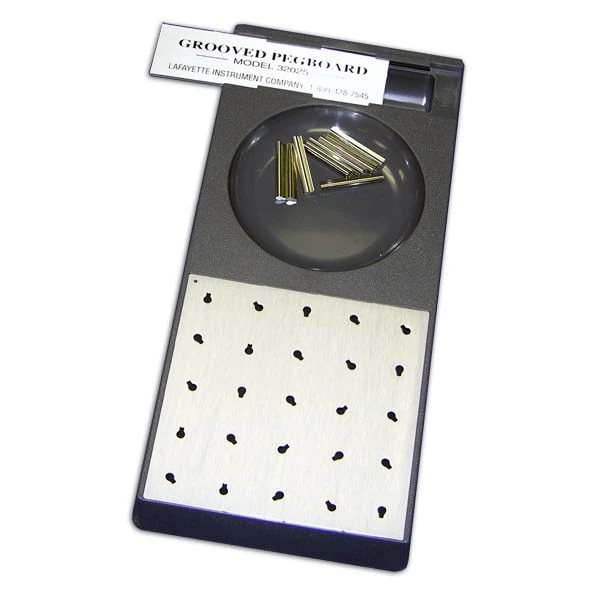
The Grooved Pegboard Test measures performance speed in fine motor tasks by examining both sides of the body. It is designed to be more challenging than standard pegboard tests, as it requires more complete hand-eye coordination, which makes it ideal for use in several neuropsychological test batteries, in student labs, as well as a screening technique in industrial environments.
What’s Included with the Grooved Pegboard Test?
The Grooved Pegboard Test includes:
- 1 x Testing board with 25 holes
- 25 x Pegs with a key along one side
- 1 x Grooved Pegboard Full Manual
- 1 x Grooved Pegboard Quick Start Guide
What Is the Grooved Pegboard Test?
This manipulative dexterity test contains 25 holes with randomly positioned slots and pegs which have a key along one side. The pegs must be rotated to match the hole before they can be inserted. This means the test with the grooved pegboard requires more complex cognitive and visual motor coordination than usual pegboard tests.
How Is the Grooved Pegboard Test Different from Standard Pegboard Tests?
A traditional pegboard is a rectangular board with two sets of 25 holes running vertically. Small metal pegs are placed in the cup on the side, while the user is required to place them vertically in the holes as rapidly as possible.
The grooved pegboard, on the other hand, features 25 holes with randomly positioned slots, which means that the pegs must be rotated before they can be inserted. This is much more challenging, and leads to very accurate results when assessing one’s fine motor skills.
Where Is the Grooved Pegboard Test Used?
The grooved pegboard test measures performance speed in a fine motor task by examining both sides of the body. The test requires more complete visual motor coordination than most of our pegboards and has been used in:
- Neuropsychological test batteries
- Student labs
- Industrial environment as a screening technique
Who Can Use the Grooved Pegboard Test?
The Grooved Pegboard Test is easy to administer, and can be performed without any prior experience or knowledge. It is often used by:
- Occupational and physical therapists for injury rehabilitation, as a tool to obtain baseline data on a patient, as well as documenting patient progress or the degree of a disability.
- Vocational evaluators to determine a subject’s ability and aptitude for certain work-related applications. It is also used to develop a specific training program, giving an individual the skills to complete a job or task that requires manual dexterity.
- Human resource directors and temporary staffing agencies who use it as a pre-employment screening and selection tool. An applicant’s performance on the pegboard test can indicate their ability to perform tasks in a job that requires manual dexterity.
How Do I Use the Grooved Pegboard?
The apparatus is placed with the peg tray oriented above the pegboard. The user is instructed to insert the pegs, matching the groove of the peg with the groove of the hole, filling the rows in a given direction as quickly as possible, without skipping any slots.
The dominant hand is tested first; when using the right hand the patient is asked to work from left to right (alternatively, the left hand works right to left). The user continues until all pegs have been placed or until a time limit of three minutes has been reached. You can read more about the testing procedure by clicking on the PDF icon below:
| Quick Start Guide |
|---|
How Do I Interpret the Results?
The score is computed for each hand separately and is usually the time required to place the pegs. Heaton et al. (2004) have developed normative data based on a large sample of Caucasians and African Americans; they provide norms separately for these two ethnicity groups, organised by age, gender and education. To find the results of the study, click on the PDF icon below:
| User’s Manual |
|---|
Be the first to review “Grooved Pegboard Test”
Related products
Active Rehabilitation
Active Rehabilitation
Electrotherapy and Magnetic Therapy
Accu-Band 800 Gauss Press Non-Plated Acupressure Magnets (24 Pack)

Balance and Posture Therapy

Hand & Wrist Therapy
Electrotherapy and Magnetic Therapy
Reviews
There are no reviews yet.